
Oujda, Benslimane, Fez, Agadir, Marrakech… everywhere in Morocco, Local Development Companies (SDL) are establishing themselves as the new face of urban transport management. Driven by the momentum of the 2025-2029 national urban transport program and the desire to break away from old delegated management models, these public limited companies are giving municipalities back control of their bus networks. But how do you create a transport SDL? Who governs it? How is it funded? And above all, what tools does it need for successful operation? Here is the complete guide, from the legal text to putting the buses into service.
What is a transport SDL?
A Local Development Company is a private joint-stock company with majority public capital, created by one or more local authorities to carry out an economic activity within their jurisdiction—in this case, the organization and operation of urban public transport.
The concept is not new: successors to mixed-economy companies (SEM), SDLs have existed under this name since the 2002 communal charter. But it is Organic Law No. 113-14 on communes (2015) that gave them their modern framework, and it is the urban transport reform initiated since 2024-2025 that has made them the preferred instrument for the new governance of mobility.
The appeal of the model comes down to three words: flexibility, control, professionalization. The SDL operates like a business (management responsiveness, recruitment of specialized profiles, commercial accounting), while remaining under the control of elected officials who hold its capital and sit on its board of directors.
The legal framework: what Organic Law 113-14 says
Articles 130 to 133 of Organic Law 113-14 on communes set the rules of the game. The essential points to know:
- Mandatory legal form: the joint-stock company (SA), governed by Law 17-95, with a board of directors.
- Majority public shareholding: the majority of the capital must be held by public legal entities. The participation of local authorities (communes, intercommunal cooperation establishments, groups) cannot be less than 34%.
- Limited purpose: industrial and commercial activities falling within the jurisdiction of the local authority; the organization of urban transport and traffic is explicitly included.
- Prohibition of subsidiaries: an SDL cannot hold shares in other companies.
- Mandatory deliberation: creation, modification of purpose, capital increase or transfer require, under penalty of nullity, a deliberation by the municipal council by an absolute majority of its acting members.
- Continuous oversight: decisions by the SDL's bodies are notified to the commune and the governor of the prefecture or province within 15 days; the municipal council is kept informed via periodic reports.
Setting up a transport SDL: the 7-step process
- 1. Preliminary study: diagnosis of the existing network, sizing of the target offer (lines, frequencies, fleet), business plan, and institutional setup. This is where the major economic balances are decided.
- 2. Deliberation by the municipal council (and other shareholder local authorities): adoption of the bylaws and capital participation by an absolute majority.
- 3. Assembling the shareholders: bringing together public shareholders: the municipality, the provincial council, the regional council, and sometimes public establishments. For example, the Taroudant SDL was established with a share capital of 4 million dirhams distributed among the municipality (1.8 MDH), the Souss-Massa region (1.6 MDH), the provincial council, and neighboring municipalities, as reported by Le360.
- 4. Legal incorporation: signing of the bylaws, filing with the registry of the commercial court, registration. The Benslimane Province Development and Transport Company (SATPB), for example, was incorporated in April 2026 following this process.
- 5. Contracting: agreement between the local authority or authorities and the SDL defining the entrusted missions, service quality objectives, and financial mechanisms.
- 6. Operational structuring: recruitment of management and teams, acquisition or reception of the fleet, setup of the depot and maintenance center.
- 7. Deployment of operating systems: ticketing, CAD/AVL (Computer-Aided Dispatch and Automated Vehicle Location), passenger information—the nervous system without which the SDL can neither collect revenue, steer operations, nor report back (we will cover this in detail below).
Governance : who decides what ?
The transport SDL is structured around three levels of governance:
- The board of directors: composed of representatives of public shareholders (and minority private ones if applicable), it sets the strategy, votes on budgets, and appoints the general manager. The presidency generally goes to an elected official from the main local authority.
- General management: it manages day-to-day operations; this is where professionalization takes on its full meaning, with profiles from transport, finance, and engineering.
- The delegating authority and oversight: the commune (or the group) remains the organizing authority; the wali or governor exercises the administrative control provided for by law. In the new national model, this triptych is reinforced by the separation between investment (borne by the State) and operation (entrusted to the SDL or an operator it supervises).
This architecture has no value unless it relies on objective data: actual revenues, kilometers traveled, punctuality, complaints. Without a reliable information system, the board of directors deliberates blindly and the delegating authority cannot exercise control. This is the number one lesson from past delegated management experiences in Morocco.
Funding: where does the money come from?
The economic model of a transport SDL is based on four complementary sources:
- Share capital: provided by the shareholder local authorities at creation (from a few million dirhams for a mid-sized city to more for large urban areas).
- The 2025-2029 national program and the FRAT: for the 84 cities involved, the acquisition of buses, ticketing and CAD/AVL systems, and maintenance centers is covered under the program, funded two-thirds by the Support Fund for Urban and Interurban Transport Reforms (FRAT) and one-third by the regions. This is a major change: the SDL no longer has to bear heavy investments.
- Operating revenues: ticketing and subscriptions, hence the vital importance of traceable ticketing that secures every dirham collected.
- Balancing contributions and ancillary revenues: potential fare compensations (social, student fares), advertising on buses and shelters, and data monetization.
To delve deeper into the budgetary aspect of the systems, consult our guide: how much does a bus ticketing system cost?
Operating tools: the nervous system of the SDL
An SDL may have new buses, a beautiful depot, and exemplary governance, but if it does not see its operations, it will fail. Four technological building blocks are essential from day one:
Ticketing: securing every dirham
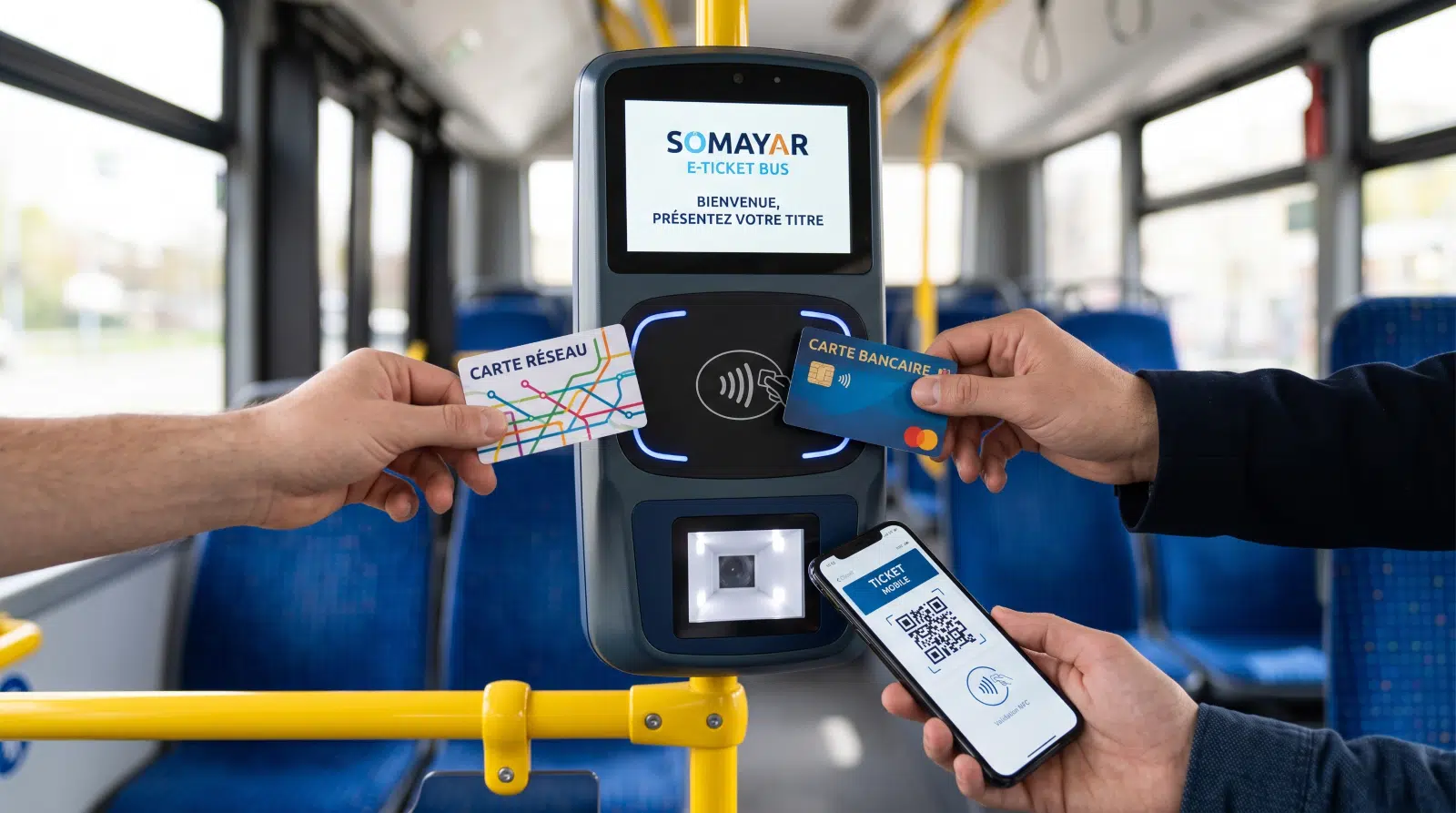
On-board sales terminals, contactless subscription cards, tracked tickets, real-time synchronization: electronic ticketing is the prerequisite for the financial transparency required by the new model. It allows the SDL to track its revenues by line, by bus, and by driver, and enables the delegating authority to control them. It also supports the fare policy: student subscriptions, civil servant plans, school subscription cards, and social pricing.
CAD/AVL: managing the fleet in real time
The Computer-Aided Dispatch System tracks each bus via GPS, monitors adherence to routes and schedules, automatically detects stops, and alerts in the event of an anomaly. It is the tool used by the operations controller and the source of the performance indicators (punctuality, commercial kilometers) upon which the SDL reports to its board.
Passenger information: winning back passengers
Real-time tracking mobile apps, voice announcements, destination displays, and screens: passenger information transforms the network's image. In Benslimane, our TarikGo application allows residents to track their bus in real time and buy their tickets online; in Oujda, the 7AFILATI app plays this role for the local SDL's fleet.
Reporting : governing through data
Revenue dashboards, occupancy rates, break-even thresholds per line, accounting exports : the reporting module supplies the board of directors, the delegating authority, and oversight bodies with precisely what Law 113-14 requires through its periodic reports.
Two SDLs, two successful deployments : the cases of Benslimane and Oujda
Theory is one thing, ground reality is another. Over the past twelve months, Somayar has supported two flagship territories of this new generation of SDLs:
- Benslimane : dans le cadre de la première phase du programme national, les 44 bus neufs de la ville sont entrés en service avec l’intégralité de la chaîne technologique billettique intelligente, SAE et application TarikGo opérationnelle dès le premier jour, sous l’égide de la SATPB nouvellement créée.
- Oujda: the local SDL operates the new fleet with our digital ticketing and real-time bus tracking via 7AFILATI, under a model separating acquisition and operations—an exact prefiguration of the national framework.
In both cases, the key to success was the same: integrating operating systems right from the project design stage, and not after the buses enter service. An SDL that launches without ticketing runs at a loss and without data—installing one after the fact costs more and disrupts operations.
The 5 success factors of a transport SDL
- 1. System specifications drafted early: ticketing, CAD/AVL, and passenger information must be defined right from the feasibility study; our guide how to choose your bus ticketing system lists the essential technical criteria.
- HTML 2. An integrated architecture: a single coherent ecosystem (ticketing + CAD/AVL + destination displays + passenger counting) rather than a patchwork of incompatible systems.
- 3. Teams trained before launch day: drivers, conductors, dispatchers, and ticket inspectors operational from day one of service.
- 4. A local, long-term technology partner: 5 to 10 years of operation require responsive, on-the-ground support in Morocco—not a distant vendor.
- 5. A data-driven culture: monthly reports to the board of directors based on real system data, not
Are you setting up or structuring a transport SDL?
Somayar supports SDLs, municipalities, and delegating authorities at every stage: network audit, assistance with technical specifications, CAD/AVL and ticketing deployment, team training, and lifetime support. Our solution is operational in 11 Moroccan cities; explore our projects and our expertise in urban bus networks across Africa.
Contact our engineers for tailored support: we put at your service the hands-on experience gained from our deployments in Benslimane, Oujda, and nine other equipped cities.
Frequently Asked Questions About Transport SDLs in Morocco
What is the difference between an SDL and traditional delegated management?
In traditional delegated management, a private operator runs the network under a concession contract. In the SDL model, the local authority establishes its own public joint-stock company, retaining control through share capital and the board of directors. The SDL offers greater public oversight while retaining the management flexibility of a private company.
What is the minimum capital required to set up a transport SDL?
Law 113-14 does not specify a minimum capital requirement beyond the standard rules for joint-stock companies (SA), but it mandates that local authorities hold at least 34% of the share capital and that public legal entities hold the majority. In practice, transport SDLs in medium-sized cities are typically established with capital of a few million dirhams.
Can an SDL operate a network spanning multiple municipalities?
Yes: the law allows inter-municipal cooperation entities (ECI) and local authority groupings to establish or participate in an SDL. In fact, this is the recommended setup for urban agglomerations where the network extends beyond the boundaries of a single municipality.
Does the 2025–2029 national program finance SDLs?
The program covers capital investment: bus acquisitions, ticketing and CAD/AVL systems, and the construction of maintenance facilities, funded by the FRAT (two-thirds) and the regional councils (one-third). Operations remain the financial responsibility of the SDL or the designated operator, funded by network revenues.
Which systems should an SDL prioritize for deployment?
Four components are essential from day one of service: electronic ticketing (revenue traceability), CAD/AVL (real-time fleet management), passenger information (mobile apps, audio announcements, onboard displays), and reporting (performance indicators for the board of directors and delegating authority).