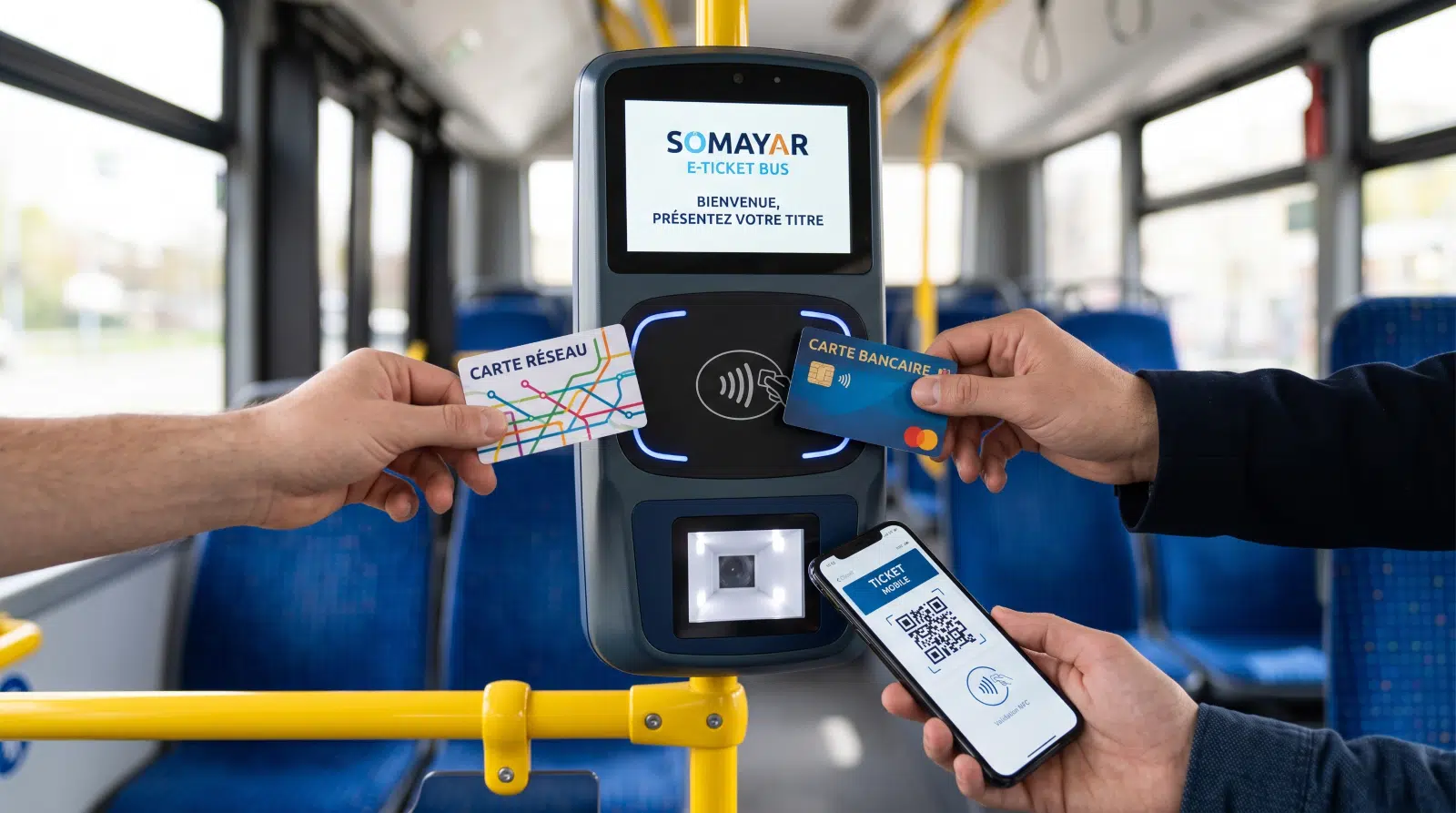
Proprietary transit card, contactless bank card, smartphone QR code: how will your passengers validate tomorrow? At a time when the 2025–2029 national urban transit program is outfitting 84 Moroccan cities with intelligent systems, transit organizing authorities, local development companies (SDLs), and operators face a pivotal choice: closed-loop, open-loop, or contactless EMV open payment? Every architecture brings its own strengths, constraints, and cost structures—and a poor decision carries consequences for the entire lifecycle of the operating concession. Below is a comprehensive comparison to guide an informed decision, backed by our field-tested recommendations across 11 deployed transit networks.
The Three Architectures in Two Minutes
Before comparing, let us clearly define the terms, as confusion frequently arises in procurement specifications:
Closed-Loop Ticketing: The Proprietary Network Card
This is the legacy and most widely used architecture worldwide. The transit authority or operator issues its own fare media: contactless subscription smart cards, prepaid cards, paper tickets, or QR codes. These transit passes work exclusively on the network that issued them. The fare balance or entitlement (subscriptions, prepaid trips) is stored either directly on the card or within the network's proprietary central system.
Typical examples include urban network student pass cards and prepaid cards reloadable at physical ticket offices. This is the architecture we deploy across Moroccan transit networks, detailed on our Bus Ticketing and AVLS/RTPI page.
Open-Loop Ticketing (Open Payment / EMV): Your Bank Card Becomes Your Ticket
Here, there is no need to issue dedicated transit cards: passengers tap and validate directly with their contactless bank card (or smartphone via Apple Pay/Google Pay). The system recognizes the card, calculates the fare—potentially applying daily or weekly caps (fare capping)—and charges the account. The global technical standard is EMV, governed by EMVCo, the technical body created by major payment schemes.
London (TfL) serves as the global showcase for this: over half of all tap-ins are made directly with bank cards.
Account-Based Ticketing (ABT): Intelligence in the Account, Not on the Card
A third approach, frequently integrated with the first two: the transit entitlement is no longer stored on the physical media, but in a centralized customer account. The card (closed-loop or bank card), QR code, or mobile phone acts purely as an identifier token. Key benefits include real-time server-side fare calculation, simplified refunds and customer service, and seamless multi-media interoperability. This is the architecture toward which modern transit networks are converging, enabling digital purchase channels such as our TarikGo platform, deployed in Benslimane.
The Comprehensive Comparison: Strengths and Limitations of Each System
Closed-Loop Ticketing: Total Control
✅ Key Strengths:
- Complete control over fare policy: student and civil servant passes, social/concessionary fares, multi-line transfers, targeted free transit—everything is highly configurable. In Morocco, social fares lie at the very heart of the public transport model (tickets at 3–5 MAD, unlimited-ride student passes).
- Total financial inclusion: no banking prerequisites required, which is a decisive factor given that a significant share of transit users (students, lower-income populations) do not carry a contactless payment card.
- Controlled and predictable costs: no interchange or acquiring bank fees per tap-in validation, and no mandatory terminal compliance certifications against strict payment network standards.
- Ridership loyalty and rich mobility data: the transit operator owns detailed visibility into its pass-holders, their origin-destination journeys, and user demographics—the fundamental raw material for service and route network optimization.
- Field-proven robustness: deployed across thousands of transit networks worldwide, mature technology, and reliable offline operation even in degraded network conditions.
⚠️ Limitations: requires setting up physical card issuance and distribution logistics (ticket offices, retail recharge networks), delivers a less seamless experience for occasional riders or visitors, and necessitates dedicated integration frameworks to achieve cross-city interoperability.
Open Payment (EMV): Frictionless Transit for Occasional Riders
✅ Key Strengths:
- Zero friction for occasional riders: tourists, visitors, and irregular passengers can board and tap immediately without purchasing fare media in advance—a major strategic asset ahead of the 2030 World Cup and its millions of anticipated international visitors.
- No fare media issuance for this segment: fewer physical cards to procure, print, and distribute.
- Modern public image: open payment has emerged as a clear hallmark of world-class, forward-thinking transit networks.
- Fare capping: automated fare caps (ensuring passengers never pay more than the equivalent daily pass rate) strike the ideal balance between operational simplicity and fare equity.
⚠️ Limitations:
- Dependence on contactless banking penetration: while contactless payments are expanding rapidly in Morocco, a large proportion of daily urban bus riders still lack access to them—relying on EMV alone would exclude the core rider base.
- Acquiring commissions and certifications: every transaction incurs banking fees, which become proportionally significant on micro-fares of 3–5 MAD. Furthermore, validators must be certified to strict payment industry standards (EMV Level 1, 2, and 3), driving up hardware and maintenance procurement costs.
- Complex concessionary/social fare integration: applying a student discount or subsidized fare to an anonymous bank card requires additional customer-linking and pre-registration mechanisms.
- Dependence on merchant acquirers and banking rails: the model relies on a fully prepared local ecosystem (acquiring banks, payment processors, and interbank clearing rules tailored specifically to transit micro-payments).
QR Code and Mobile Ticketing: The Third Contender Not to Overlook
Bridging the two worlds, digital smartphone ticketing (dynamic QR codes purchased online and scanned onboard) stands out as a pragmatic complement: zero physical media to issue, no costly EMV certifications for onboard validators, and a modern digital experience tailored for connected users. This is precisely the online ticketing model powered by TarikGo—already fully operational in Benslimane—delivering key benefits of open payment without its associated constraints.
The 7-Criteria Matchup (Decision Matrix)
- Inclusion of unbanked riders: Closed-loop ✅✅ | EMV ❌ | Mobile QR ✅ (requires a smartphone).
- Concessionary & social fare policies (students, targeted discounts...): Closed-loop ✅✅ | EMV ⚠️ Complex | QR ✅.
- Occasional riders & tourists: Closed-loop ⚠️ | EMV ✅✅ | QR ✅.
- Transaction processing cost: Closed-loop ✅ (zero) | EMV ⚠️ (merchant fees/commissions) | QR ✅.
- Equipment capital expenditure (CapEx): Closed-loop ✅ | EMV ⚠️ (certification costs) | QR ✅.
- Rider data ownership & loyalty programs: Closed-loop ✅✅ | EMV ⚠️ (anonymous) | Mobile QR ✅.
- Brand image & international appeal: Closed-loop ⚠️ | EMV ✅✅ | Mobile QR ✅.
The takeaway is unequivocal: no single architecture wins across the board. The strategic question is therefore not “which one to choose,” but rather “in what sequence to combine them.”
Our Recommendation for Moroccan Transit Networks: The 3-Horizon Strategy
Drawing upon our field deployments across 11 Moroccan cities—from Tétouan to Oujda, via Benslimane—here is the phased roadmap we recommend to contracting authorities and Local Development Companies (SDLs):
Horizon 1 (Starting Today): The Closed-Loop Foundation, Built for Scalability
Closed-loop ticketing remains the indispensable backbone for Moroccan networks: it serves 100% of the population, supports concessionary and social fare policies, and safeguards transit revenues free from third-party commissions. However—and this is the pivotal factor—it must be deployed on a future-proof, scalable architecture: multi-format onboard validators capable of reading alternative media down the road, a central back-office designed around Account-Based Ticketing (ABT-ready), and open, well-documented APIs. That is the critical distinction between a system that upgrades seamlessly via software and one that requires a full, costly rip-and-replace.
Horizon 2 (Near Term): Mobile and QR Code as an Agile Complement
Online ticketing and dynamic QR scanning deliver modern, frictionless convenience without banking friction: it is the fastest track to full dematerialization, a model already proven in Benslimane via TarikGo. The smartphone is effectively the true open payment of everyday Morocco, boasting a penetration rate that vastly outpaces that of contactless bank cards.
Horizon 3 (Medium Term, Target 2030): Targeted EMV as an Overlay Layer
As the 2030 World Cup draws closer, EMV acceptance becomes increasingly vital—yet strictly as a targeted overlay for occasional riders and international visitors, rather than a wholesale replacement for the closed-loop foundation. Major metropolitan areas and host cities will find strategic value in rolling it out across key transit arteries (airport corridors, stadium connections, urban city centers), capitalizing on onboard hardware that is already payment-ready. International standards championed by the UITP consistently point toward these hybrid, multi-token architectures as the benchmark for resilient transit systems.
The 6 Critical Questions to Ask Your Fare Collection Vendor Before Signing
- 1. Are your validators multi-format ready? Supporting closed-loop smart cards today, mobile QR codes tomorrow, and contactless EMV down the road—without replacing onboard hardware.
- 2. Is your back-office system ABT-ready? An Account-Based Ticketing architecture is the prerequisite for all future developments (multi-token support, dynamic fare capping, multi-modal interoperability).
- 3. Do I retain full data ownership? Standardized automated exports, zero proprietary vendor lock-in—crucial for post-contract sovereignty and governance.
- 4. What is the total cost of ownership over 8 years? Hardware acquisition, maintenance SLAs, interchange/merchant transaction fees, and system scalability—our transit ticketing budget guide details the full TCO calculation methodology.
- 5. How do you handle offline/degraded operations? A resilient transit network must ensure continuous validation and fare enforcement even during complete connectivity loss.
- 6. Who delivers technical support, and from where? An automated fare collection system operates for 8 to 10 years: demand a partner with an established, local operational footprint in Morocco and proven reference deployments—consult our guide on how to choose your bus ticketing system in Morocco.
What We Concretely Deploy
Our E-Ticket Bus solution operationalizes this 3-horizon strategy: a complete closed-loop automated fare collection system (onboard validators, multi-profile contactless smart cards, thermal paper ticketing), integrated seamlessly with CAD/AVL and passenger information systems (SAE/PIS), along with a dedicated mobile application ecosystem (TarikGo, 7AFILATI) driving paperless ticketing on an open architecture engineered to absorb tomorrow's innovations. Extensively field-proven across 11 Moroccan networks, backed by full staff training and ongoing lifecycle technical support. Explore our portfolio of deployments.
Get in touch with our systems engineers for an architectural scoping workshop: we analyze your transit network, demographic ridership profiles, and modernization milestones to deliver a tailored, turnkey Closed-Loop/QR/EMV strategic roadmap.
Frequently Asked Questions About Transit Ticketing Systems
What is a closed-loop ticketing system?
It is a system in which the transit network issues its own fare media (contactless smart cards, tickets, QR codes) valid exclusively within its operational perimeter. It delivers absolute sovereign control over fare policies—particularly concessionary and social tariffs—and serves all riders seamlessly, whether banked or unbanked.
What is EMV open payment in public transit?
It is the ability for riders to validate their trip directly using a contactless debit/credit bank card or NFC smartphone, without purchasing a transit pass in advance. The underlying technical standard is EMV, established by EMVCo. While ideal for occasional travelers and tourists, it relies on riders having contactless payment instruments and incurs banking interchange/merchant fees on every fare transaction.
Can EMV completely replace travel pass cards?
In practice, no—particularly in Morocco. Concessionary social fares (students, civil servants) and financial inclusion for unbanked riders require maintaining a closed-loop system. Leading global networks combine both: a closed-loop core for everyday commuters, with EMV operating as an overlay for occasional travelers and tourists.
What is Account-Based Ticketing (ABT)?
An architecture where transit entitlements and balances reside in a central back-office account rather than on the physical smart card. The physical media (card, QR code, smartphone) functions merely as an authentication token. ABT streamlines fare rule updates, customer support, and the integration of emerging media—making it the essential technical prerequisite for modern multi-token transit ecosystems.
Which system should a Moroccan transit network choose in 2027?
Our recommendation: establish a robust closed-loop ticketing core on an open, modular architecture (multi-format onboard validators, ABT-ready central back-office), expand rapidly via online purchasing and mobile QR ticketing, and layer in targeted contactless EMV acceptance as 2030 approaches to seamlessly accommodate visitors and occasional riders.
External Resources: EMVCo: Technical Specifications for the EMV Standard; UITP: International Association of Public Transport.