Heatwaves and fire risk: Why Moroccan buses and trucks must get equipped this summer
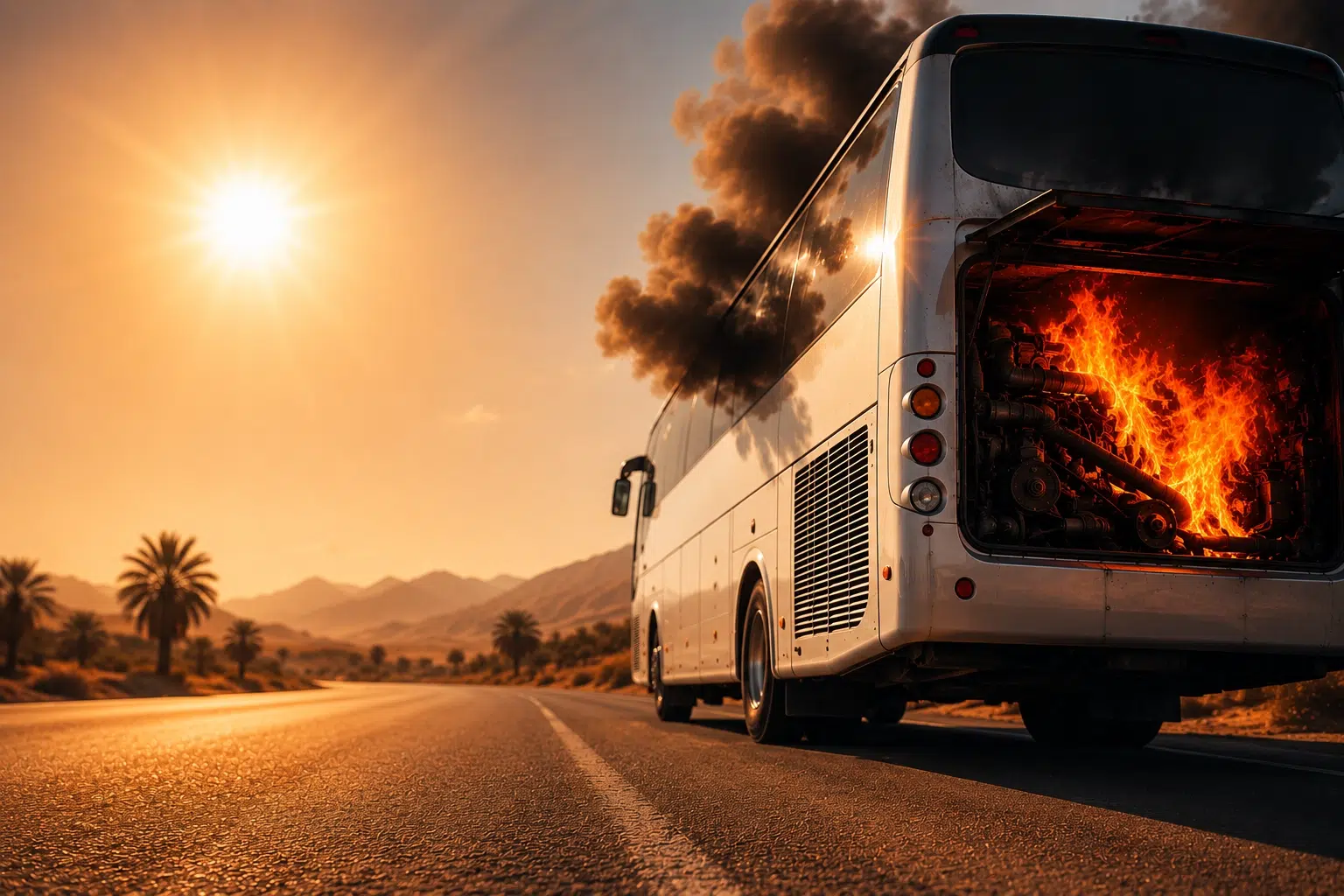
Every summer, extreme temperatures affecting various regions of Morocco—from Marrakech to Ouarzazate, as well as major highways like Casablanca–Tangier and Agadir–Laayoune—heighten a risk that is too often underestimated: vehicle fires. An overheated engine compartment, an electrical system pushed to its limits by air conditioning, and tires and brakes reaching high temperatures: conditions are ripe for a minor malfunction to escalate into a major disaster.
For passenger transport operators (CTM, Supratours, SATAS, tourist transport companies) and freight carriers, a fire outbreak is never just a matter of property damage. It is a human risk (passengers, drivers), a reputational risk (social media, press), and an immediate financial risk (downtime, loss assessment, replacement, higher insurance premiums).
Why heat increases the risk of fire in heavy vehicles
Un moteur de bus ou de camion fonctionne déjà à haute température en conditions normales (80–100 °C en régime permanent). Lorsque le thermomètre extérieur dépasse 40 °C, plusieurs facteurs s’additionnent dangereusement :
- Accelerated engine compartment overheating, particularly during long trips, in the mountains (Zad Pass, Tizi n’Tichka), or while queuing at border crossings.
- Maximum strain on the electrical system: continuous air conditioning, generators for tourist coaches, multimedia systems, GPS, backup cameras—all potential sources of short circuits.
- Increased risk of fluid leaks or ignition (engine oil, fuel, coolant, AdBlue) upon contact with overheated surfaces (turbocharger, exhaust manifold, DPF).
- Significantly faster fire spread in the event of a fire outbreak, due to ambient heat and relative wind at highway speeds.
- Aging fleet: a significant portion of Moroccan coaches and trucks are over 10 years old, with weakened wiring harnesses.
In this context, traditional fire suppression systems (portable fire extinguishers, stored-pressure powder systems, simple electrical detection) quickly show their limitations: pressure loss over time, corrosion, false alarms, and reliance on the vehicle battery, which is often the first victim of a fire.
What the standard says: UNECE R107, the global benchmark
International regulation UNECE R107 (UN Economic Commission for Europe Regulation No. 107) governs fire safety in buses and coaches (categories M2 and M3). It notably mandates:
- Properly sized and accessible emergency exits
- Flame-retardant materials in the passenger compartment
- Automatic detection and automatic fire suppression systems in the engine compartment (Annex 8, testing according to method SP 4912)
La certification E1 107 R-080052 (délivrée par le KBA allemand) est la preuve ultime de conformité. Se mettre en conformité n’est plus une option pour les opérateurs qui souhaitent répondre aux appels d’offres publics (ONCF, collectivités, transport scolaire, tourisme institutionnel) et rassurer leurs voyageurs comme leurs assureurs.
La solution Protecfire Detexline 4V : une extinction automatique sans électricité, sans pression, 100 % mécanique
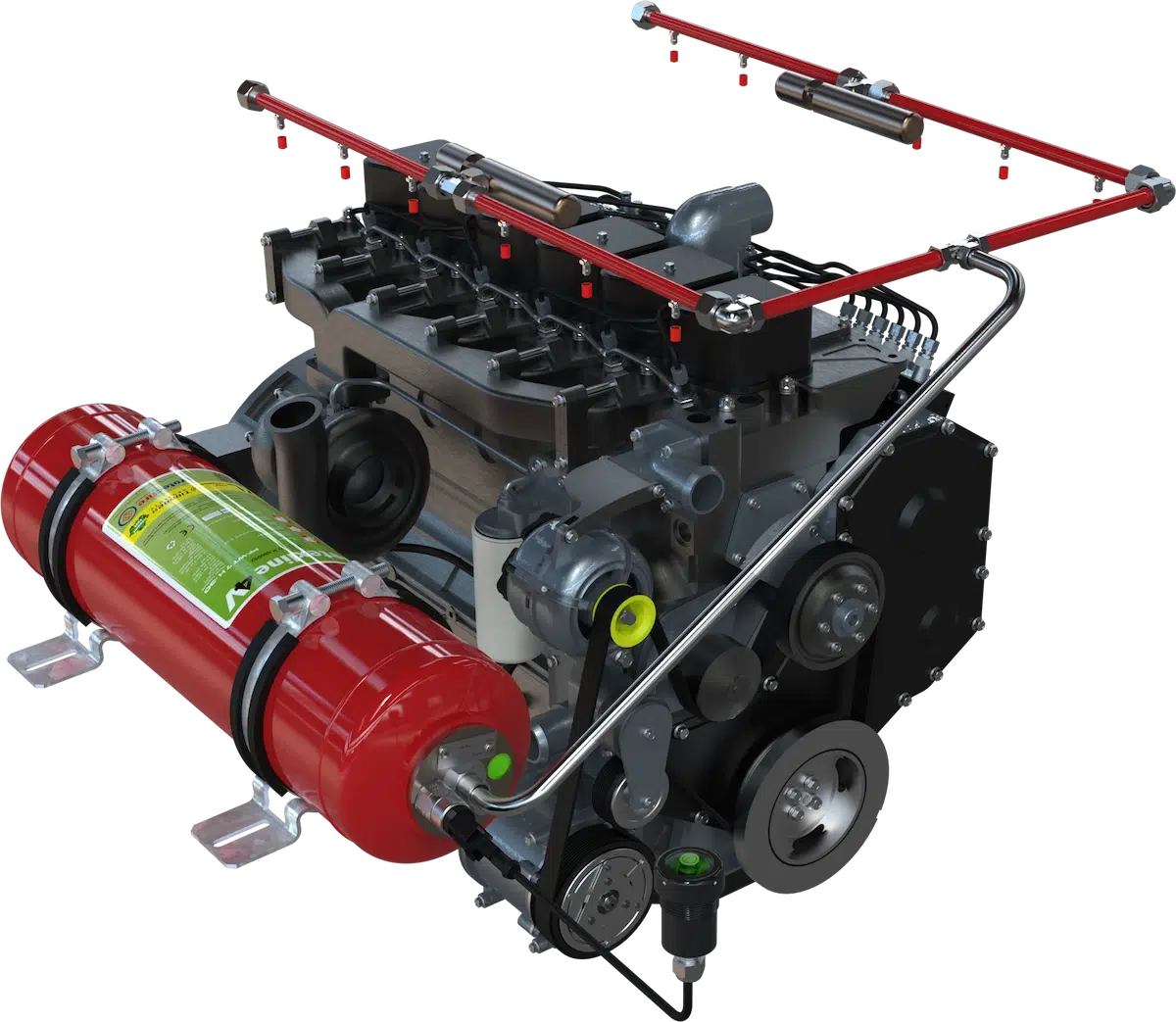
Distributed exclusively by Somayar in Morocco, the Protecfire Detexline 4V system relies on patented technology, made in Germany, which has proven itself worldwide (certified UNECE R107, KBA, winner of the Busworld Innovation Award 2025).
Its revolutionary principle: fully pneumatic-mechanical detection and suppression, which depend neither on an electrical power supply nor on prior pressurization.
How it works in practice
| Component | Function | Innovation |
| SPY® Thermo-pneumatic detectors | Abnormal temperature detection | 9 trigger ranges (57 °C → 260 °C), RTI 12 (ultra-fast), stainless steel, 10-year lifespan |
| Single line detexline | Detection + suppression in a single 12 mm pipe | 50% faster installation, fewer drillings, stainless steel |
| Non-pressurized tank (4 / 7 / 14 / 24 L) | Extinguishing agent storage | Zero pressure in standby no leaks, no corrosion, sealed argon/N2 cartridge |
| Fine-Spray nozzle bars (S1/K1) | Micro-droplet spraying | 90° angle, stainless steel, anti-clogging, full compartment coverage |
| TiboRex Absolute® Agent | Suppression through cooling + smothering | Fluorine-free, biodegradable, class A/B/F, food-safe |
Activation sequence (100% autonomous):
- A SPY detector reaches its setpoint temperature (e.g., 180 °C near the turbo, 110 °C near the wiring harnesses)
- Its glass bulb bursts → argon cartridge opens → pressure buildup in the detexline
- This pressure opens the tank's N2 cartridge → agent propelled toward the nozzles
- Fine spray: micro-droplets absorb heat energy + form a smothering film preventing re-ignition
- Pressure switch sends an optical/acoustic alarm signal to the driver's cab
7 decisive advantages for Moroccan fleets
| # | Advantage | Why it changes everything in Morocco |
| 1 | Zero electricity | Triggers even if the battery has melted or if the circuit breaker has been activated—the #1 cause of fires does not disarm protection |
| 2 | Zero standby pressure | No pressure loss, no corrosion, no 10-year pressure vessel requalification (TPED) |
| 3 | Zero false activation | Only precise, zone-selected thermal thresholds trigger activation—no electrical sensors sensitive to vibrations, humidity, or rats |
| 4 | Ultra-light maintenance | Annual visual inspection only—part replacement every 10 years (cartridges + detectors) |
| 5 | Multizone & sectorization | A single tank can protect engine + battery compartment (EV) + parking + wheels with distinct temperatures per zone |
| 6 | EV Ready / Hydrogen Ready | E-Spy detector dedicated to Li-ion batteries (detection + integrated stainless steel nozzle) + directional valves for independent zones |
| 7 | Fast installation | ~3 hours per bus single line, pre-drilled nozzles, no wiring, no pressurization |
Why equip your fleet before the end of summer
The months of July and August statistically account for the highest number of vehicle fire interventions in Morocco, in particular:
- On highways (A1, A2, A3, A4) where speed + load + heatwave = an explosive cocktail
- In high-heat regions (South, Haouz, Tadla, Oriental) where ground temperatures exceed 50 °C
- On tourist coaches driving slowly (sightseeing, mountain passes) with air conditioning on full blast
Waiting until the end of the season to equip your fleet is taking an avoidable risk for passenger safety, business continuity, and your reputation with public and private clients.
Somayar: your official Protecfire partner in Morocco
As an official Protecfire integrator, seller, installer, and maintainer, Somayar supports operators from A to Z:
- On-site technical study: engine compartment audit, zone definition, selection of SPY temperatures, tank sizing (4/7/14/24 L)
- Certified installation: by our factory-trained technicians, compliance with UNECE R107, acceptance report
- Driver/maintenance team training: manual triggering operation, daily visual checks
- Annual & 10-year maintenance: framework contract, original parts, full traceability
- Permanent stock in Morocco: tanks, detectors, nozzles, TiboRex agent, cartridges, short lead times
Ready to secure your fleet before the heatwave? Don't let summer decide for you. A technical diagnostic is free, with no obligation, and can be done at your depot.