A bulldozer catching fire means, on average, millions of dirhams going up in smoke in just a few minutes. Pelles hydrauliques, chargeuses, tombereaux, foreuses, grues mobiles : les engins miniers et de chantier concentrent tous les ingrédients d’un incendie dévastateur. Moteurs surchauffés, hydraulique sous haute pression, carburant, poussières inflammables, le tout souvent loin de tout secours. Sur les grands sites marocains, miniers comme BTP, la question n’est plus « si » mais « quand ». La réponse s’appelle Detexline 4MC : le système d’extinction automatique de Protecfire, conçu spécifiquement pour les machines off-road, que Somayar déploie au Maroc en tant que distributeur officiel. Voici pourquoi il s’impose sur les chantiers qui ne peuvent pas se permettre de brûler.
Why do construction and mining machinery catch fire so frequently?
Industry statistics speak for themselves: heavy machinery ranks among the most exposed industrial equipment when it comes to fire risk. Four factors combine to create this hazard:
- Extreme heat: turbochargers reaching several hundred degrees, brakes and engines under continuous strain, often under the blazing Moroccan sun. A cocktail we have already documented for road vehicles during heatwaves, and one that is even more severe on mining machinery;
- L’hydraulique sous pression : une durite qui cède pulvérise un brouillard d’huile inflammable sur les surfaces chaudes. C’est le scénario d’ignition le plus fréquent sur les machines de chantier ;
- L’environnement : poussières de charbon ou de minerai, débris végétaux pour les machines forestières et agricoles, boues chargées d’hydrocarbures qui s’accumulent dans les compartiments moteur ;
- Isolation: a haul truck at the bottom of a pit or a drill rig in an underground gallery is tens of minutes away from first responders. By the time firefighters arrive, nothing remains but the chassis.
Consequences: total loss of an asset worth millions of dirhams, production downtime often far more expensive than the machinery itself, life-threatening risk to the operator, and, in underground galleries, a risk of asphyxiation for the entire crew.
Detexline 4MC: fire protection engineered for off-road machinery
The Detexline 4MC (Mining & Construction) is the off-road version of the patented technology by Protecfire, a VdS-certified German manufacturer. It equips mining machines, construction machinery, tunnel boring machines, forestry and agricultural equipment, mobile cranes, and rail vehicles.
The principle: detect and extinguish without human intervention
- 1. Continuous thermal detection: a pneumatic detection tube runs through high-risk areas (engine compartment, hydraulic pumps, turbo, brakes). In the event of a fire outbreak, the tube responds to heat at the exact point of the fire;
- 2. Instant automatic triggering: the rupture of the tube releases the extinguishing agent directly onto the fire source within seconds, before flames can spread;
- 3. Targeted suppression: the agent (liquid, powder, or combined depending on configuration) smothers the fire source and cools the surfaces to prevent reignition;
- 4. Operator alert: the driver is alerted and can safely evacuate while the system operates.
The Protecfire signature: non-pressurized, electricity-free
This is what sets Protecfire's patented technology apart from conventional systems: the device operates without a permanently pressurized tank and without an electrical power supply. In practical terms:
- Zero false alarms: no electronics to malfunction under vibration, dust, or humidity—the scourge of electronic systems on heavy machinery;
- Guaranteed operation when the engine is off: even with the battery disconnected and the machine parked overnight, the system remains 100% operational. Yet a large portion of machinery fires break out after shutdown, when residual heat ignites accumulated deposits;
- Extreme robustness: engineered to withstand the shocks, vibrations, and harsh temperatures of mining sites;
- Simplified maintenance: no permanent pressure checks and no electronic components to recalibrate.
Certifications that speak to project owners and contractors
On major industrial and mining sites, a safety system is only as good as its certifications. The Detexline 4MC boasts a rare track record:
- SP Method 4912:2019 : le protocole d’essai de référence pour les systèmes d’extinction des engins lourds, avec tests de performance feu et de résistance environnementale ;
- RISE P-mark: certification from the Swedish research institute RISE, awarded in 2026 for the Detexline 4V and 4MC product lines. It is one of the most demanding standards worldwide for on-board fire suppression;
- DMT / TÜV Nord: approval for underground and open-cast mining in Germany, the benchmark standard for mining operations;
- SBF 127:17: the Swedish standard for internal combustion engine vehicles (construction, forestry, heavy machinery);
- UNECE R107 : l’homologation européenne de la série Detexline, que nous détaillons dans notre article sur la protection incendie des autocars et bus ;
- ISO 9001:2015 / VdS certified manufacturing and CE marking.
For an HSE manager or procurement officer in the mining sector, these certifications mean one thing: the system is field-proven under the world's most demanding conditions, from German mines to Scandinavian forests.
On the Moroccan ground: who is affected?
On the Moroccan ground: who is affected?
- Mining sites: phosphate, silver, zinc, cobalt. Fleets of hundreds of machines operate continuously, both open-pit and underground, where the stoppage of a critical asset costs hundreds of thousands of dirhams per day;
- Major infrastructure projects: stadiums and infrastructure for the 2030 World Cup, starting with the Grand Stade Hassan II in Benslimane, port expansions, railway lines, highways, and dams;
- Quarries and cement plants: crushers, wheel loaders, and haul trucks exposed to extreme dust and heat;
- Mechanized agriculture and forestry: combine harvesters and forestry machines, where fires can engulf entire operations in summer;
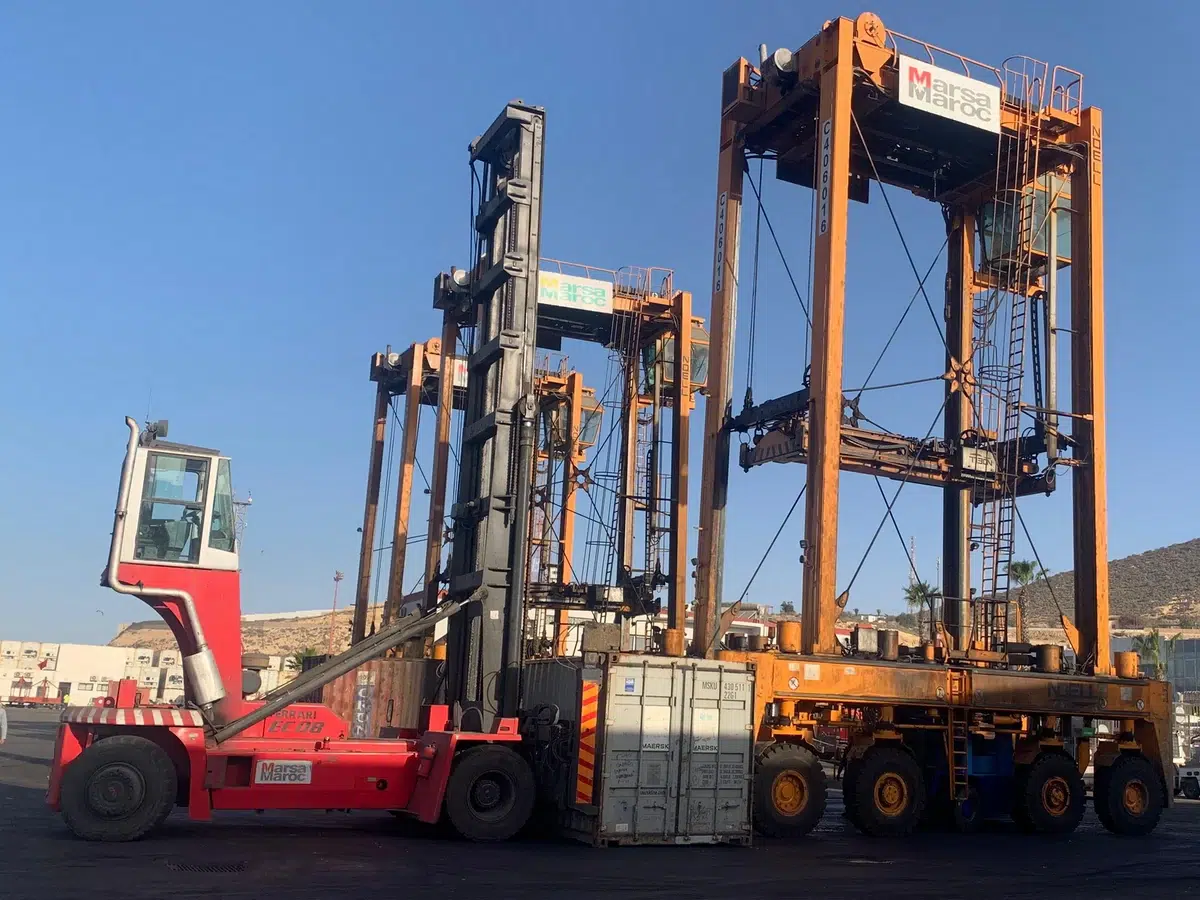
- Ports and terminals: straddle carriers, reach stackers, and material handling equipment, such as those we equipped for Marsa Maroc (see below);
- Tunnel boring machines and underground construction: the most critical environment of all. It is specifically for this setting that the 4MC's mining approvals were engineered.
💡 The Somayar insight: on mining sites, vehicle fire suppression pairs naturally with ATEX radiocommunications—specifically the explosion-proof Hytera radios detailed in our industry-by-industry professional walkie-talkie guide. A single integrator safeguarding both personnel and heavy machinery: that is the true strength of the Somayar model.
Already in the field: Marsa Maroc and ONEE place their trust in us
In Morocco, the Detexline is not just a catalog promise: it already protects strategic machinery fleets, installed directly by Somayar teams.
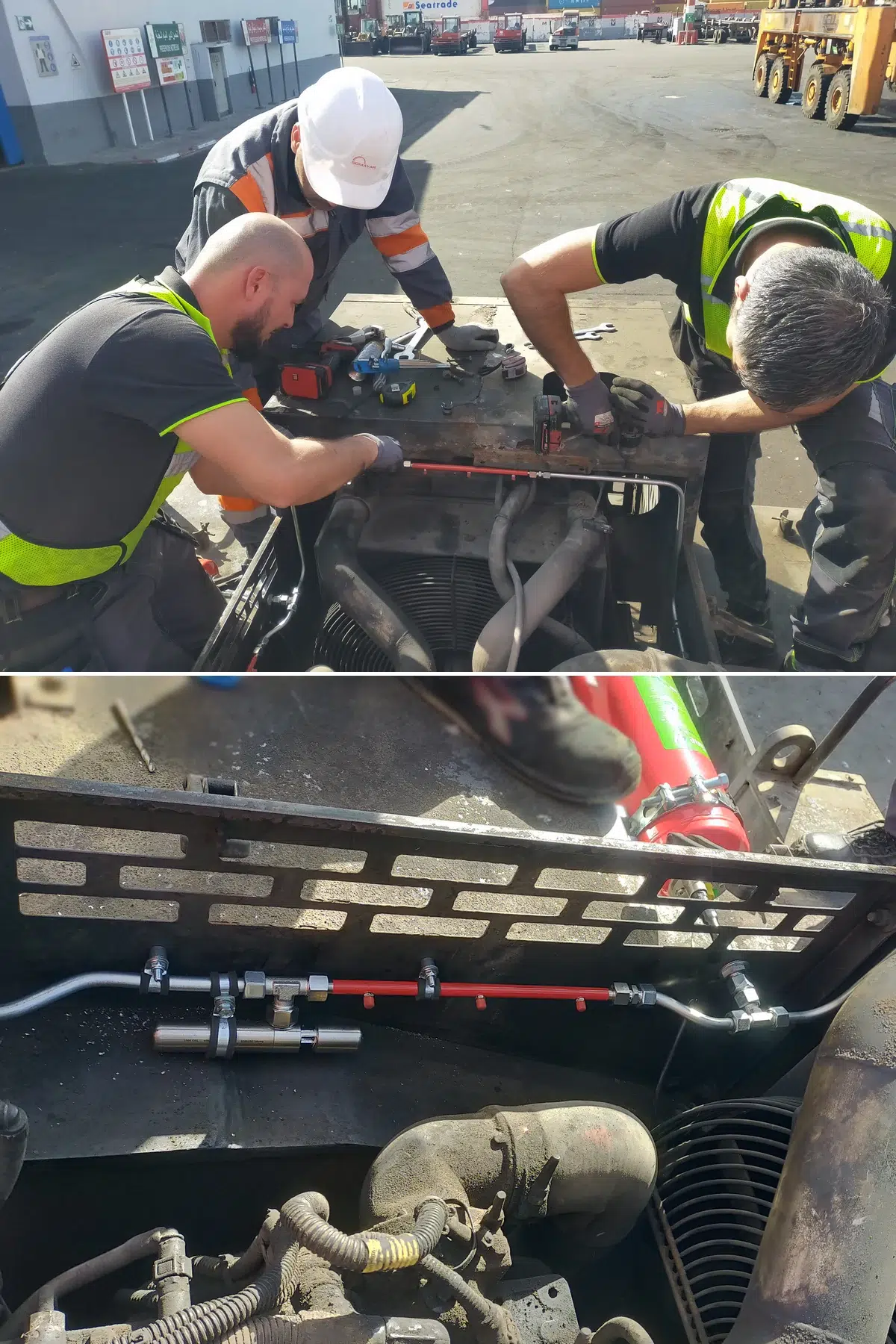
At Marsa Maroc, the national port operator, our technicians fitted terminal handling equipment: straddle carriers, reach stackers, and yard machinery. These machines operate around the clock at the core of port operations, in an environment where a vehicle fire threatens not only the equipment itself, but also the cargo containers and the terminal's operational continuity.
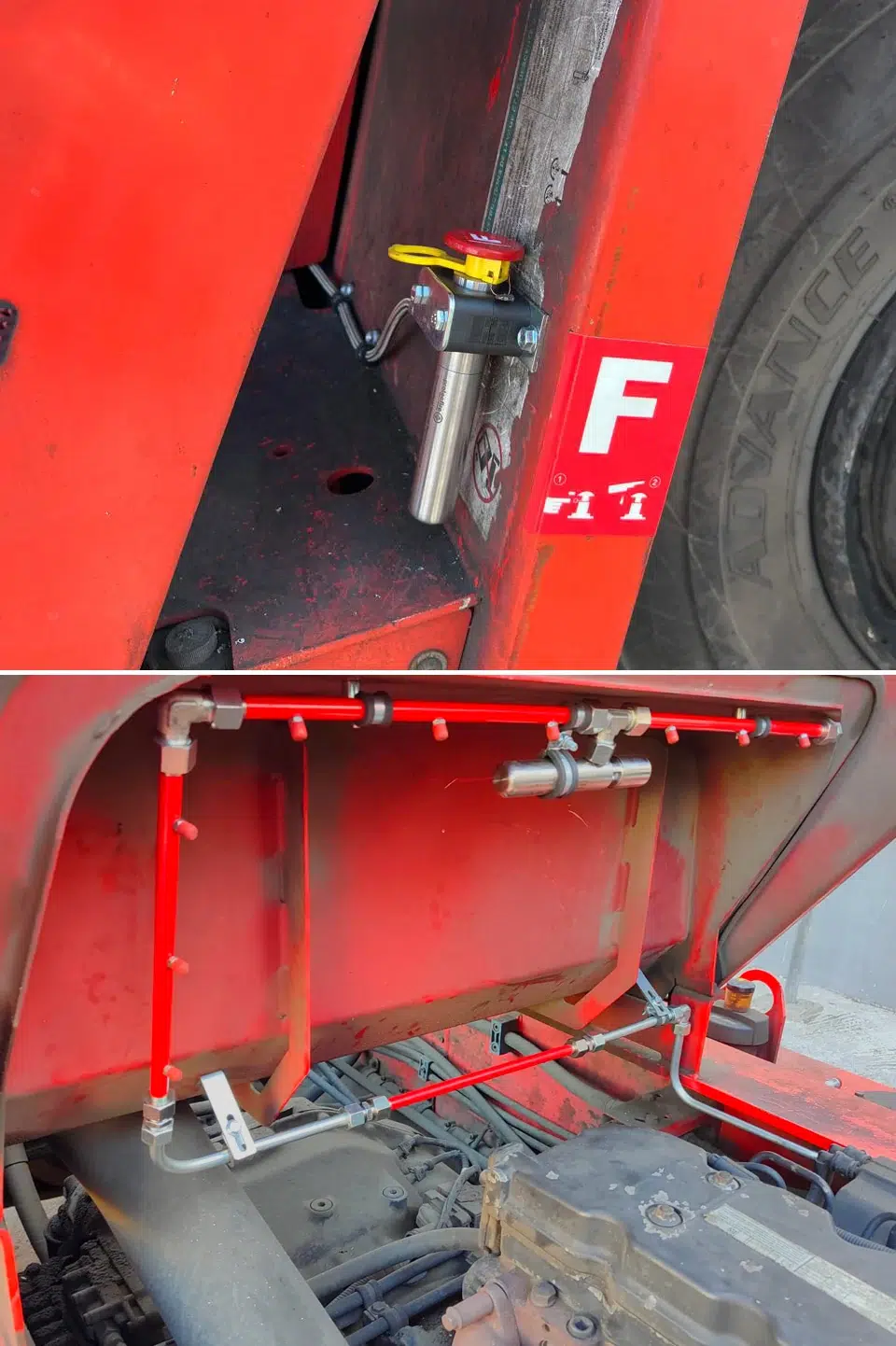
At the National Office of Electricity and Drinking Water (ONEE), our systems protect the assets of the national energy and water utility, where service continuity is a matter of critical national importance.
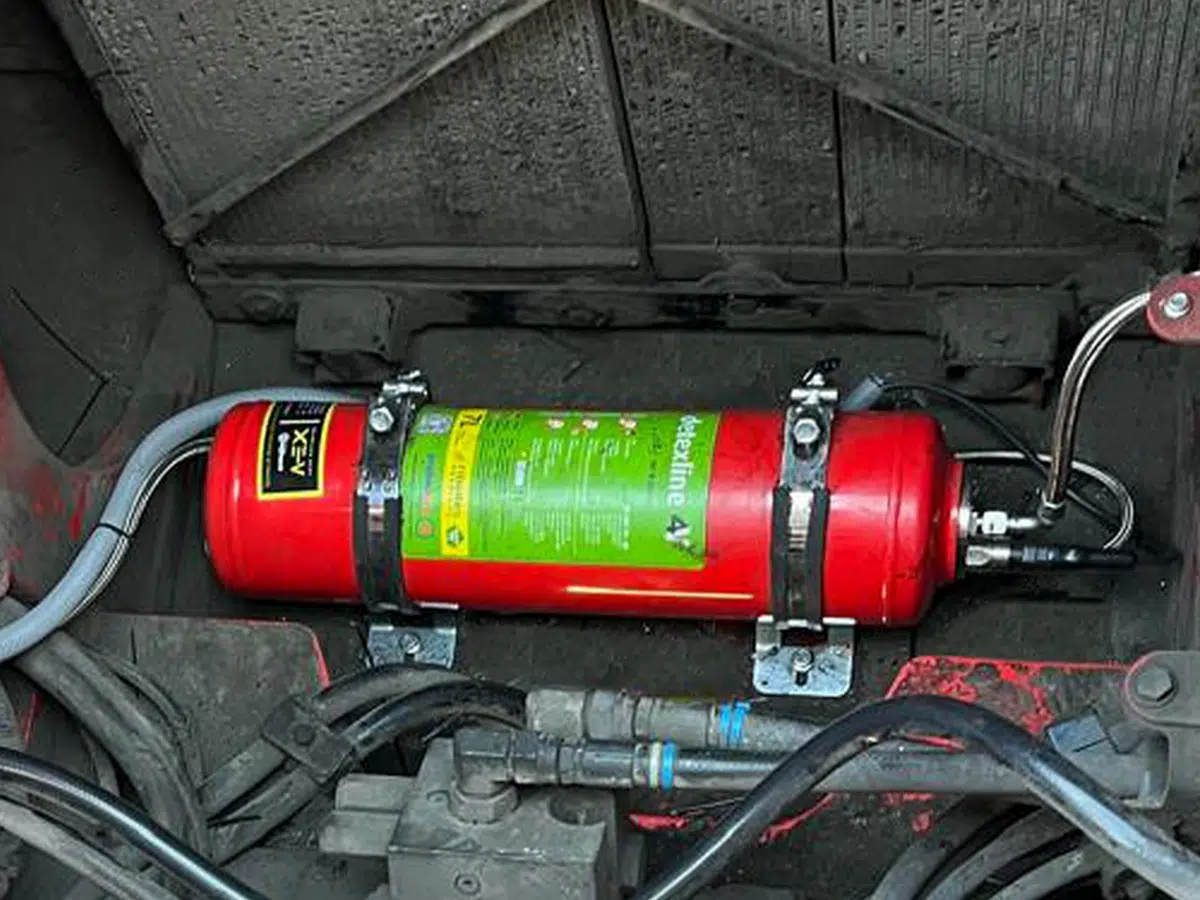
These installations provide tangible proof of the Somayar method: custom-routed detection tubing throughout the engine compartment, discharge nozzles positioned directly adjacent to critical hot spots, chassis-mounted Detexline storage cylinders, and an easily accessible actuation valve. Everything is executed on site, ensuring minimal machinery downtime.
The business case: insurance that pays for itself
Let's look at this from a fleet manager's perspective. When weighing the cost of an automatic fire suppression system, consider what is on the other side of the scale:
- Asset value: from 1 to over 30 million MAD for high-capacity mining equipment. Without automated suppression, an engine-bay hydraulic fire almost always results in a total loss;
- Downtime costs: halted production while waiting for replacement machinery, with lead times often stretching from 6 to 18 months;
- Insurance premiums: industrial underwriters place significant value on certified automatic fire suppression. Some now make it a mandatory condition for covering mining fleets;
- Principal contractor compliance: major industrial groups increasingly integrate onboard fire suppression into their HSE standards and subcontracting tender requirements;
- And above all: the operator's life, which is priceless.
Relative to the asset value it safeguards, the system typically represents less than 1 to 2% of the machine's purchase price. Very few safety investments deliver such a compelling return.
Turnkey deployment by Somayar: from audit to ongoing maintenance
As the official Protecfire distributor in Morocco, Somayar manages the entire lifecycle, applying the same proven methodology used for our vehicle and commercial kitchen automatic fire suppression systems:
- 1. Machine-by-machine risk audit: mapping critical hazard zones (engine, hydraulics, turbocharger, brakes) based on equipment model and operating conditions;
- 2. Tailored system sizing: custom routing for detection tubing, extinguishing agent volume calculations, and discharge nozzle placement. Every machine receives a dedicated configuration validated by Protecfire engineering;
- 3. On-site installation: our certified technicians deploy directly to your work site or mining facility, keeping machinery downtime to an absolute minimum;
- 4. Team training: hands-on instruction for operators and maintenance crews covering system operation, routine visual checks, and post-discharge protocols;
- 5. Maintenance and recharging: periodic inspections, post-activation recharging, OEM parts, backed by the fast turnaround of a local team.
An emerging risk to anticipate: electric and hybrid machinery
The energy transition is also reshaping heavy worksites: electric loaders, hybrid machinery, and on-site energy storage systems. Lithium-ion batteries introduce a fundamentally new fire risk—thermal runaway and re-ignition—for which Protecfire develops dedicated solutions engineered specifically for battery-powered vehicles and energy storage facilities. We will cover this in-depth in an upcoming article: fleets transitioning to electric power must integrate this dimension into their HSE standards today.
Protect your fleet before the next fire ignites
Every week of operation without protection is a gamble, with millions of dirhams and human lives at stake. Our engineers deliver an on-site fire risk audit for your machinery fleet: comprehensive hazard analysis per machine, certified engineering recommendations, and precise cost estimates, with zero obligation. You can also explore the full scope of our projects across fire safety, transport solutions, and radio communications.
Contact our team to schedule an on-site audit for your facility: mine, quarry, construction site, or agricultural operation.
Frequently asked questions about automatic fire suppression for heavy machinery
How does an automatic fire suppression system work on heavy equipment?
A thermal detection tube runs through critical hazard zones (engine, hydraulics, turbocharger). In the event of a fire outbreak, it reacts to heat at the exact focal point of the blaze and automatically releases the extinguishing agent within seconds, without any human intervention even when the machine is shut down and the battery is disconnected.
Why choose an unpressurized and electricity-free system?
Because the vibrations, dust, and moisture on worksites compromise electronic systems, leading to false alarms and detection failures. Protecfire’s patented, purely mechanical and pneumatic technology eliminates these risks and remains operational 24/7—even when the engine is switched off, a critical window when many fires break out.
Is the Detexline 4MC certified for underground mining?
Yes: it holds DMT / TÜV Nord approval for both underground and surface mining operations, in addition to certifications under SP Method 4912:2019, RISE P-mark (2026), and SBF 127:17. Manufacturing is ISO 9001:2015/VdS certified.
Which types of machinery can be equipped?
The entire off-road range: excavators, wheel loaders, haul trucks, bulldozers, drill rigs, tunnel boring machines, mobile and crawler cranes, forestry and agricultural machinery, as well as rail vehicles. Every installation is custom-engineered based on the specific machine model and operating conditions.
How much does it cost to equip a machine?
The cost depends on the machine's size and the hazard zones to be protected, but it typically represents less than 1 to 2% of the asset's total value. Our engineers provide an accurate quote following a free audit of your fleet.
External resources: Protecfire: Detexline 4MC, fire suppression systems for mining and construction machinery; Protecfire: RISE P-mark certification for Detexline 4V and 4MC ranges (2026).